
String and hybrid inverters
Solar Inverter Repair in Scottsdale, AZ
The inverter is the part of a solar system most likely to fail. We find out why it stopped and what it takes to get it running.
- Free written estimate after the system is tested, not guessed from the driveway
- Itemized pricing: parts, labor, roof work and any utility or city paperwork on separate lines
- City permit and utility requirements checked before any work is scheduled

When the Box on the Wall Stops Working
Solar Inverter Repair is one of the most common fixes Scottsdale solar owners need, because the inverter does the hardest job in the system. It takes the direct current coming off the roof and turns it into the alternating current your house and the grid use, all day, often while mounted on a stucco wall that bakes in the afternoon sun. When it stops, the whole array stops with it, even if every panel is fine.
Signs your inverter needs attention
- A red, orange or blinking status light where it used to be green
- An error or fault code on the display or in the monitoring app
- A blank screen during daylight hours
- Production that drops to zero for part of the day, often in the afternoon
- Clicking, buzzing or a fan that runs constantly or not at all
- A burning smell or discoloration near the case or the wiring below it
Why heat matters so much
Inverters carry a rated operating temperature range, and most protect themselves by cutting output once internal temperatures pass a set point. On a west-facing wall in Scottsdale, where the average July high is above 104 degrees, that point can arrive by early afternoon. The result looks like a system that works in the morning and fades later in the day. Sometimes the fix is mechanical: a clogged fan, a heat sink caked with dust, or a missing sun shield. Sometimes the unit is just at the end of its life, since electrolytic capacitors and cooling fans wear faster in sustained heat.
What we test
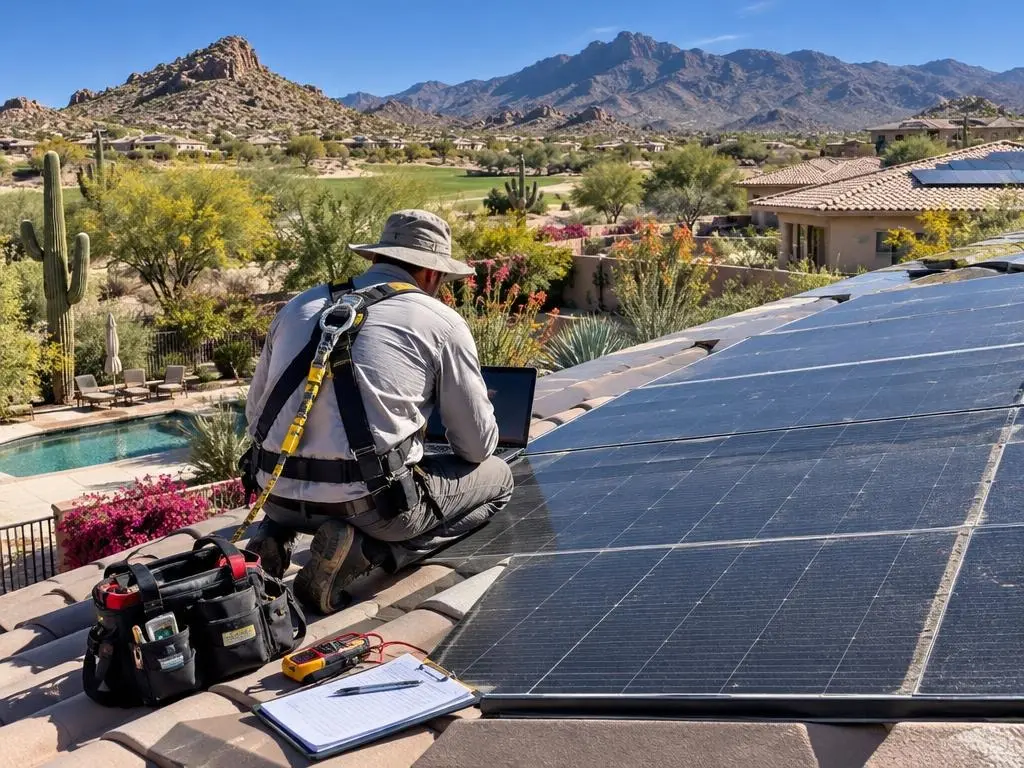
We start with the fault history the inverter stored, because the code usually points to the side of the problem: the panels and DC wiring, the inverter itself, or the grid connection. Then we measure open-circuit voltage and current on each string, check for ground faults and insulation problems, inspect connectors and the DC disconnect for heat damage, and confirm the AC breaker and utility voltage are within range. Many shutdowns turn out to be outside the inverter, such as a damaged connector on the roof or a tripped breaker, and those cost far less to fix.
Repair or replace
Some inverters can be repaired in place by replacing a fan, a communication card or a fuse. Others are sealed units where the practical fix is a replacement. If the unit is still under its manufacturer warranty, we document the fault so you can file a claim, which may cover the part. When a replacement is needed on an older system, we size it to match your array and check whether the newer model changes anything with your utility, APS or SRP, or with the city. A hybrid or battery-ready model is an option if you are thinking about storage, but it is never required to fix the problem.
Monitoring that went quiet
A common complaint is not a dead inverter but a dead monitoring app. Wi-Fi passwords change, routers get replaced, and older cellular modems lose service when networks shut down. The system may still be producing. We check the inverter's own display first, then reconnect monitoring so you can see problems the next time they happen.
Inverter Problems We Fix
Most inverter calls fall into one of these groups.
Fault codes and shutdowns
Reading stored errors, finding whether the cause is on the DC side, inside the unit or on the grid side, and correcting it.
Heat derating
Cleaning fans and heat sinks, adding shade where the manufacturer allows, and confirming clearances so the unit stops throttling on hot afternoons.
Ground and arc faults
Tracing damaged wire insulation, pinched conductors or failed connectors that trip the inverter's safety shutdowns.
Inverter replacement
Sizing and installing a compatible replacement when repair is not practical, with the utility and city requirements checked first.
Monitoring reconnection
Restoring Wi-Fi, Ethernet or cellular links so production data reaches your app again.
What Sets the Price of Inverter Repair
| Factor | How it affects the estimate |
|---|---|
| Cause of the fault | A tripped breaker or failed connector is a small repair; a failed power board or a full replacement is the larger end. |
| Warranty status | A unit still under manufacturer warranty may have the part covered, leaving labor and diagnosis. |
| Inverter type and size | Replacement cost tracks the inverter's capacity and whether it is a standard or battery-ready model. |
| Utility and city paperwork | Swapping to a different model can require utility notice or a permit, which adds time and fees. |
Ranges vary with the fault, the equipment and the warranty. Your written estimate is the price.
How Inverter Repair Works
1. Share what you see
Send a photo of the inverter screen or the app error, plus the inverter model if you have it.
2. Test on site
We pull the fault history and test strings, wiring, disconnects and the AC connection.
3. Written estimate
You get the cause, the fix and the price on paper, including any warranty claim we can help document.
4. Repair and paperwork
Parts are installed once any utility notice or permit the change needs is in place.
5. Verify output
We confirm the inverter is converting power and that monitoring shows it.
Solar Inverter Repair Questions
How long does a solar inverter last?
String inverters usually wear out well before the panels do, often somewhere in the second decade, and sustained heat shortens that. Microinverters and optimizers are rated for longer, but individual units still fail. The model, the warranty length and where the unit is mounted all matter.
My inverter works in the morning but shuts off in the afternoon. Why?
That pattern often points to heat derating or high grid voltage. A clogged fan, direct afternoon sun or a cramped mounting spot can push the unit past its temperature limit. High utility voltage can also cause it to disconnect for safety. Testing tells which it is.
Can I reset the inverter myself?
Many inverters have a documented shutdown and restart sequence in the owner's manual, and following it is safe when done exactly as written. If the fault comes back, stop resetting it and have it tested, because repeated faults can point to wiring damage.
Will a new inverter change my utility agreement?
A same-model swap usually does not. A different model or capacity can require updated paperwork with APS or SRP, and we check before installing.
Solar Inverter Repair Service Areas
- Solar Panel Repair in Scottsdale, AZ
- Solar Panel Repair in Old Town Scottsdale, AZ
- Solar Panel Repair in McCormick Ranch, AZ
- Solar Panel Repair in Gainey Ranch, AZ
- Solar Panel Repair in DC Ranch, AZ
- Solar Panel Repair in Grayhawk, AZ
- Solar Panel Repair in Troon, AZ
- Solar Panel Repair in Silverleaf, AZ
- Solar Panel Repair in Pinnacle Peak, AZ
- Solar Panel Repair in Desert Mountain, AZ
- Solar Panel Repair in McDowell Mountain Ranch, AZ
- Solar Panel Repair in Fountain Hills, AZ
- Solar Panel Repair in Cave Creek, AZ
- Solar Panel Repair in Carefree, AZ
- Solar Panel Repair in Rio Verde, AZ
- Solar Panel Repair in Paradise Valley, AZ
- Solar Panel Repair in Kierland, AZ
Get a Solar Inverter Repair Estimate
Send a photo of the inverter screen and we will set up a test.